














Long before satellites and telescopes, people all over the world were already looking up — and writing down what, or who, they believed they saw coming from the sky. From the Sumerians of ancient Mesopotamia to the Maya of Central America, dozens of unrelated cultures left behind stories of tall, powerful beings who arrived from the heavens, taught humans the basics of civilization, and were later remembered as gods. The Bible itself speaks of the Nephilim, described in Genesis as “men of renown,” the offspring of beings called “sons of God” and human women. Greek mythology has its Titans, Norse legend its Jötunn, and Hindu texts their towering Daityas. The sheer number of cultures, separated by oceans and centuries, that independently recorded memories of giant or god-like visitors is one of the details researchers in this field keep coming back to.
It was the Sumerian clay tablets that gave the modern theory its name: the Anunnaki. Independent researcher Zecharia Sitchin spent decades translating cuneiform texts and argued that the Anunnaki were not simply gods in the poetic sense, but a real, physically advanced species that traveled to Earth from a planet he called Nibiru. According to Sitchin’s reading of the tablets, it was Enki — one of the most prominent Anunnaki figures, associated with wisdom, fresh water, and creation — who played a direct hand in shaping early humans, possibly to serve as laborers for the Anunnaki’s mining operations. Sitchin’s translations remain controversial among traditional Assyriologists, but his work opened the door for a wave of researchers asking the same question: what if these “myths” were closer to historical accounts than we assume?
Swiss author Erich von Däniken pushed the conversation further by looking not at texts, but at structures. His “ancient astronaut” theory points to monuments around the world that, in his view, are too precise, too massive, or too strange to be explained by primitive tools alone. The ziggurats of Babylon are a favorite example: stepped, pyramid-like towers, some rising over 90 meters, built with an alignment and scale that still puzzles engineers today. Von Däniken and like-minded researchers have suggested these structures functioned as something closer to landing platforms or ceremonial sites built to honor — or even welcome back — beings who came from the stars. The famous Tower of Babel, many note, may itself be a folk memory of one of these ziggurats.
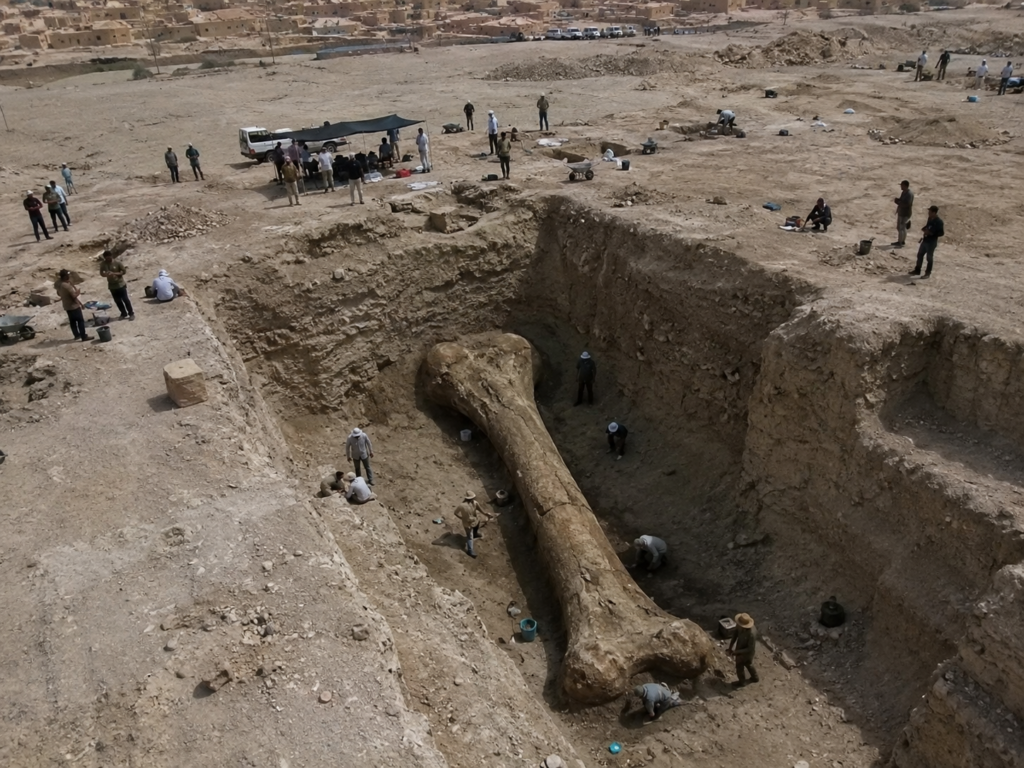
Then there is the physical evidence that keeps the giant theory alive in popular imagination: oversized skeletons. Reports of unusually large human remains have surfaced for over a century, but one of the most talked-about cases in recent years involves a skeleton reportedly unearthed in China, with bones described as far larger than average human proportions, sparking intense debate online about whether a race of giants once lived alongside ordinary humans. Similar claims have circulated about remains found in the United States during the 1800s, some allegedly measuring well over two meters tall, and discoveries described in parts of Eastern Europe and South America. Mainstream archaeologists generally attribute such cases to skeletal disorders, misidentified animal bones, or outright fabrications staged for publicity — and it’s worth noting that no giant skeleton has ever been independently verified by a peer-reviewed scientific study. Even so, the persistence and consistency of these reports across so many different regions is exactly what keeps believers convinced there’s more to the story than official explanations admit.
What makes the Anunnaki and Nephilim theory so compelling to so many people isn’t just one piece of evidence — it’s the pattern. Ancient texts describing sky-beings, monumental architecture that still defies easy explanation, and recurring legends of giants from completely disconnected civilizations all pointing in a similar direction. Whether one reads it as literal history, distorted memory, or pure myth, the questions raised by Sitchin, von Däniken, and the generations of researchers who followed them haven’t gone away. If anything, each new claimed discovery — like the alleged Chinese giant skeleton — only adds fuel to a debate that has been burning for thousands of years: were the gods of the ancient world simply stories, or memories of something that actually walked among us?