















A new study confirms what astronomers have long suspected: our planet’s ice ages are not random catastrophes, but predictable consequences of orbital mechanics. And according to the latest models, the next glaciation is expected to begin within approximately 11,000 years — a blink of an eye in geological time. But to understand what that means for humanity, we must first look back at what the last ice age did to our ancestors, our ecosystems, and perhaps to civilizations we have not yet fully uncovered.
The Milankovitch Clock
Earth does not orbit the Sun in a perfect circle, nor does it spin on a perfectly upright axis. It wobbles, tilts, and stretches its orbit in slow, rhythmic cycles — a phenomenon described in the early 20th century by Serbian mathematician Milutin Milankovitch. These three overlapping cycles — eccentricity (the shape of the orbit), axial tilt, and precession (the wobble of Earth’s axis) — combine every roughly 100,000 years to reduce the amount of solar energy reaching the Northern Hemisphere. When that energy dips below a critical threshold, snow stops melting in summer, ice sheets begin to grow, and the planet enters a glacial period. The recent study reinforces this model with high-resolution climate data, confirming that the last major glaciation was triggered precisely by these orbital mechanics — and projecting that the next one, absent human-induced warming, would begin in approximately 11,000 years. The irony is sharp: the same civilization that might delay an ice age through greenhouse gas emissions also inherited its very intelligence from a previous one.
Ice, Protein, and the Birth of the Human Mind
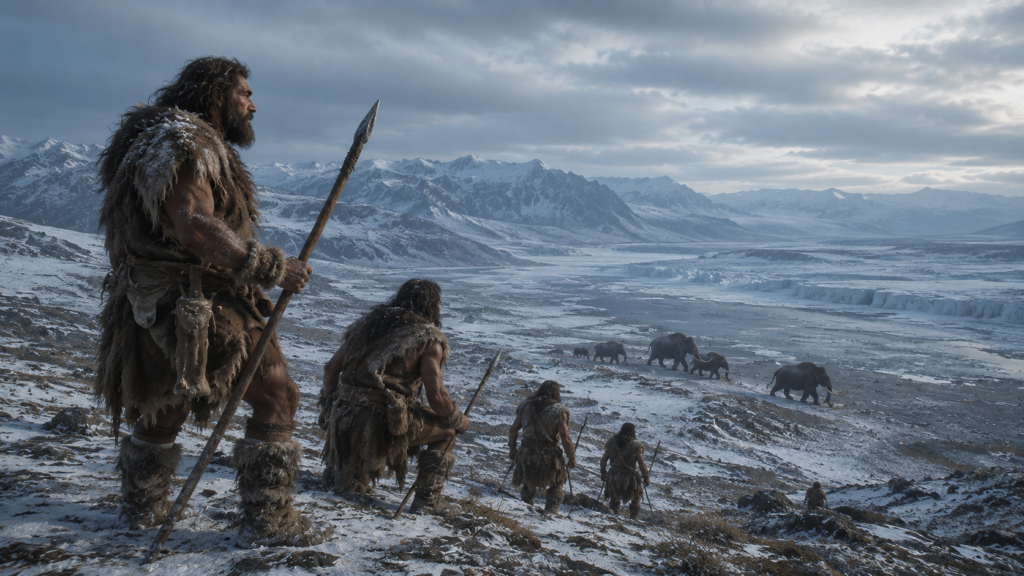
When the last glacial maximum gripped the planet — roughly 26,000 to 19,000 years ago — vast portions of the Northern Hemisphere were buried under ice sheets several kilometers thick. Forests retreated. Fruiting plants became sparse. The rich plant-based diets that hominins had relied upon for millions of years grew scarce across much of the world. Faced with starvation, early humans turned increasingly to animal protein: megafauna, fish, migratory birds, and insects. This dietary shift may have been one of the most consequential accidents in evolutionary history. Protein and fat-rich diets provided the caloric density needed to sustain a metabolically expensive organ — the brain — at larger sizes. Some researchers argue that this nutritional pressure, combined with the social complexity required for cooperative hunting in harsh environments, drove a decisive acceleration in cognitive development. Anatomically modern humans began crafting increasingly sophisticated tools: barbed harpoons, bone needles for sewing insulating garments, and flint-knapped blades that could bring down animals ten times their size. The ice, in a brutal sense, sharpened us.
A Planet Half-Frozen: The Question of the Tropics
But did the entire planet freeze? The evidence suggests not — and the distinction matters enormously. The last glacial maximum was not a global snowball. Ice sheets advanced aggressively across North America, northern Europe, and northern Asia, while sea levels dropped by as much as 120 meters as water became locked in glaciers. However, the tropics — the band of equatorial land encompassing much of what is today sub-Saharan Africa, the Amazon basin, Southeast Asia, and Central America — appear to have survived as refugia: cooler and drier than today, but not glaciated. This is speculative in parts, but the fossil and pollen record strongly suggests that tropical biodiversity persisted through the ice age in ways that high-latitude ecosystems could not. If human populations survived the worst of the glaciation by retreating toward equatorial refugia, it would explain the extraordinary genetic diversity found in African populations today — a signature of a species that weathered the cold in the one place the ice did not reach.
The Great Dying: Sabertooths, Mammoths, and the Megafauna Collapse
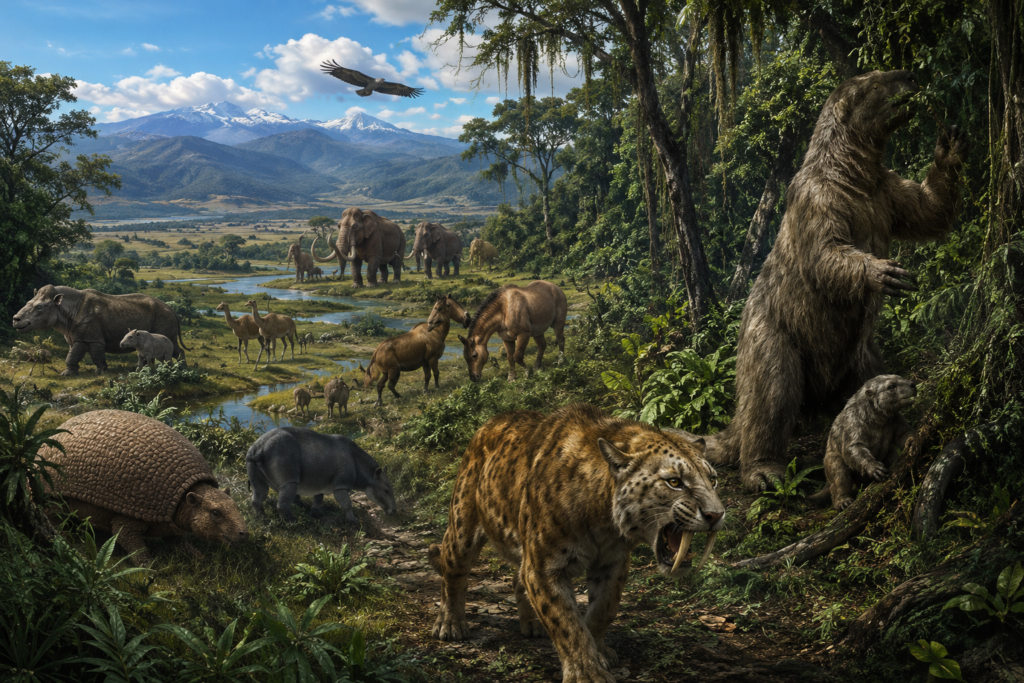
The end of the last ice age, roughly 11,700 years ago, coincided with one of the most dramatic extinction events in recent geological history. The megafauna — the giants of the Pleistocene — vanished with startling speed. The woolly mammoth (Mammuthus primigenius), a creature that had roamed the Northern Hemisphere for hundreds of thousands of years, disappeared from continental land masses by around 10,000 BCE. The saber-toothed cat (Smilodon fatalis), with its iconic 28-centimeter canines, went extinct in the Americas around the same time. The giant ground sloth (Megatherium americanum), some species of which weighed up to four tons and stood taller than an elephant on hind legs, also vanished across most of its range. The cause of this mass extinction remains vigorously debated. The two leading hypotheses — climate change at the end of the ice age, and overhunting by newly arrived human populations — are not mutually exclusive. It is plausible, even likely, that the warming climate stressed megafauna populations that were then pushed to extinction by coordinated human hunters wielding exactly those tools that the ice age had forced them to develop. If so, humanity’s first great ecological crisis was written in the bones of animals we helped to kill.
Lost Civilizations? The Gap Before History
Here lies perhaps the most haunting speculation of all. The last glacial maximum ended around 11,700 years ago. The oldest confirmed archaeological sites of complex human civilization — Göbekli Tepe in modern Turkey, dated to approximately 9600 BCE; the proto-urban settlements of the Fertile Crescent; Jericho, one of the oldest continuously inhabited cities, dating to around 8000 BCE — all post-date the end of the ice age by centuries or millennia. They are, in geological terms, recent. This raises an uncomfortable question: could organized human societies have existed before the ice ended, during the glacial maximum itself, in tropical refugia or coastal regions now submerged under 120 meters of risen seawater? The honest answer is that we do not know — and that the absence of evidence is not evidence of absence when the ocean floor has swallowed the most habitable coastal margins of the Pleistocene world. Some researchers point to anomalous megalithic structures, unexplained genetic signals, and mythological flood traditions shared across disconnected cultures as circumstantial hints of a pre-Holocene social complexity we have not yet recovered. It remains speculation. But the mathematics is sobering: modern Homo sapiens has existed in its current anatomical form for at least 300,000 years. The idea that for 290,000 of those years nothing resembling organized society ever emerged — only for it to appear suddenly in multiple locations at roughly the same time, just after the ice melted — deserves, at the very least, an open and curious mind.
The next ice age, if orbital mechanics hold true, will arrive regardless of whether anyone is watching. What it will find when it gets here depends entirely on choices made in the 11,000 years between now and then.