





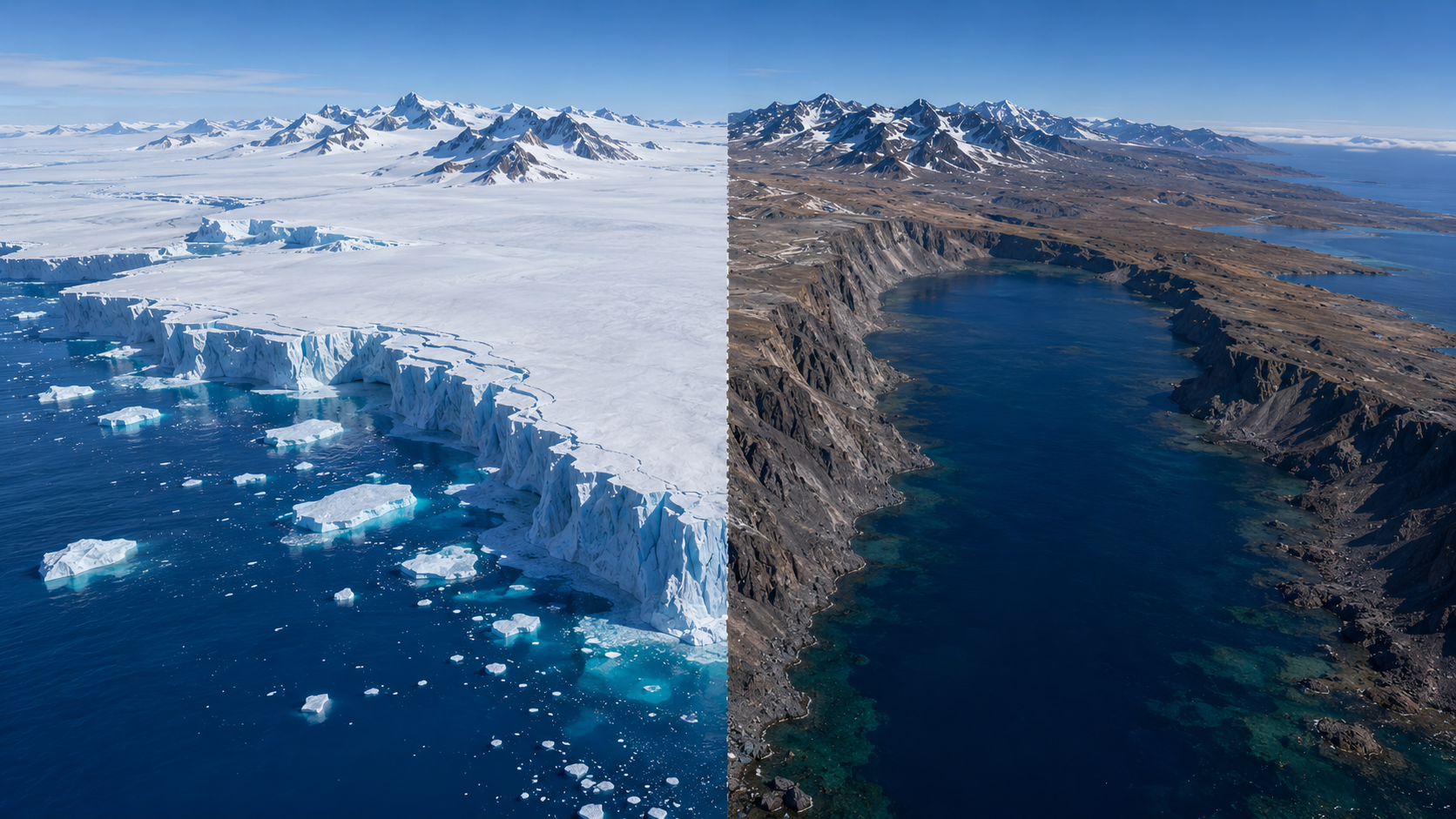
Scientists have identified a vast, ancient river landscape preserved beneath the East Antarctic Ice Sheet — a relic of a time before the continent was covered in ice. The terrain has survived almost untouched for millions of years, hidden under nearly two kilometers of ice.
A Landscape Older Than the Ice Sheet Itself
The discovery was published in Nature Communications by a team led by Stewart Jamieson of Durham University, alongside researchers from Newcastle University, the University of Texas at Austin, and Imperial College London. The study identified an extensive, undisturbed landscape sitting beneath the central East Antarctic Ice Sheet (EAIS), shaped by rivers long before the ice sheet formed roughly 34 million years ago.
Unlike most of Antarctica’s bedrock, which has been ground down and reshaped by glacial movement over millions of years, this terrain escaped that fate. It remains a buried record of a continent that once had flowing water, open valleys, and exposed land surfaces — conditions unlike anything seen there today.
Where It Was Found
The landscape sits in the Aurora-Schmidt subglacial basins, in the interior of East Antarctica, less than 350 kilometers from the edge of the ice sheet and near the Denman and Totten glaciers — two glaciers closely monitored because of their sensitivity to past and future warming.
Key details from the study:
- The terrain consists of three highland blocks separated by deep valleys.
- Together, the landscape spans about 300 kilometers — roughly the size of Wales.
- It lies under approximately 2 kilometers of ice.
- It likely formed between 34 million and 60 million years ago.
How Researchers Saw Through the Ice
No drilling was needed to map the hidden terrain. Researchers combined satellite imagery with radio-echo sounding (radar) surveys collected during airborne campaigns over the region between 2008 and 2011. By analyzing subtle variations in ice-surface slope and radar reflections from the bedrock below, they reconstructed the shape of a landscape no human has ever seen directly.
Why It Survived
The key to the landscape’s survival lies in ice temperature at its base. In many parts of Antarctica, “warm-based” ice grinds against the bedrock, eroding and reshaping it over time. In this region, however, the ice above the ancient terrain has remained cold-based and largely stable, acting more like a protective shell than an abrasive force.
Before large-scale glaciation took hold, Antarctica still carried the geological fingerprints of its separation from the supercontinent Gondwana, with a climate capable of sustaining rivers and surface drainage.
What It Means for Ice Sheet Behavior
According to the British Antarctic Survey, this buried topography helps explain how the ground beneath the ice sheet influences its movement. Even hidden from view, ancient plateaus and valleys can affect how fast — and in which direction — glaciers flow toward the ocean. That matters for climate modeling:
- Flat, elevated surfaces can slow ice flow in some areas.
- Buried valleys help channel glacial movement.
- Slower glaciers can shift projections of future sea-level rise.
- Climate models become more accurate when they account for the real shape of the land beneath the ice.
What Comes Next
Confirming the exact age of the landscape will require further work. A borehole roughly 1.9 kilometers deep could reach sediment layers beneath the ice and help pin down when the terrain was sealed off from the surface.
It’s an ambitious undertaking, but scientists say the payoff would be significant: understanding this buried world could sharpen predictions of how the East Antarctic Ice Sheet — and global sea levels — might respond as the planet continues to warm.